What to Expect
Carrie strives to create an individualized experience for each client while staying true to core theoretical approaches and foundational beliefs.
In the space where hope meets courage, healing begins.

Guiding Beliefs
Carrie approaches situations from the perspective that all behavior makes sense. A central focus of her work is becoming curious about what lies beneath a client's behavioral responses. She recognizes humans are biologically wired for connection and believes a critical component of healing is a client's experience of connection, felt safety, and validation not only within the therapy space but outside of the therapy space as well. Carrie draws on research from various leaders in the field of interpersonal neurobiology to guide her work with clients.
Play Therapy
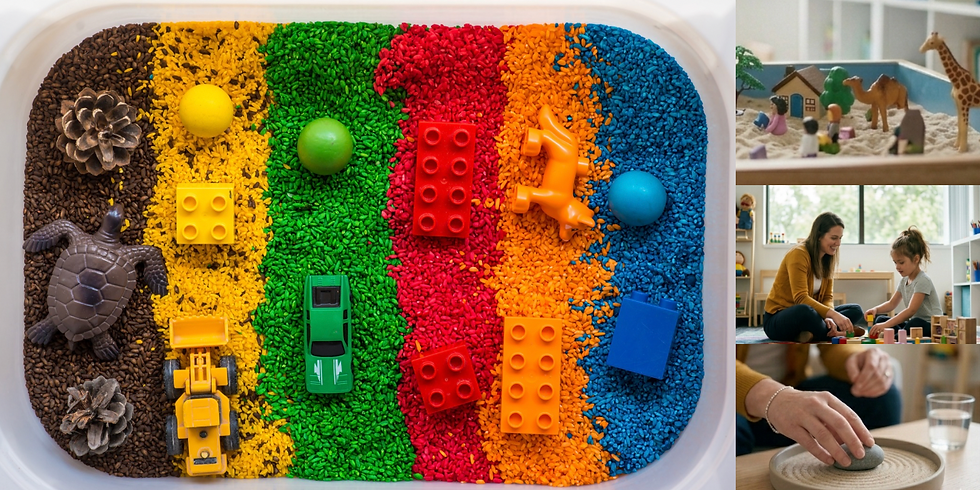
Carrie has specialized training, grounded in various theoretical models, in applying the therapeutic powers of play. In play therapy, the toys become the words and play becomes the language a child uses to communicate (Landreth, 2002).Trained play therapists understand how to use these moments of play to support emotional healing and growth. Through a trusting relationship and developmentally appropriate activities, play therapy helps children express themselves, work through challenges, and build important skills for their overall well-being.
A common misconception is play therapy exists solely for young clients. While certain theoretical models are geared toward younger clients, Carrie has received specific training to incorporate playful expression elements into her work with clients of all ages.


EMDR
Recognizing the nervous system's powerful role in shaping how a person experiences their world, Carrie knows talk therapy often isn't enough. She has specialized training in Eye Movement Desensitization and Reprocessing (EMDR), a research-based integrative psychotherapy. In EMDR, we recognize that difficult past experiences can sometimes get "stuck" in the nervous system, making it hard to navigate the present when our bodies remember what our minds are trying to move past.
Bilateral stimulation—such as guided eye movements or rhythmic tapping—helps the brain reprocess these stuck memories. The goal is to help the nervous system heal the underlying memory networks, effectively "lowering the volume" on the emotional charge of the past so that future experiences feel less triggering and more manageable.
Carrie is trained to use this deeply creative and adaptive healing tool for both adults and children. By weaving together the therapeutic powers of play with EMDR, this dual approach allows children to process their big feelings through their natural language—play—unlocking a path toward lasting resilience and well-being.